Australian Labor Party

Australian Labor Party
The Party for all Australians

Thursday, 23 October 2014

Protestors Gather To Express Outrage Over Death Of Ms Dhu | newmatilda.com

Protestors Gather To Express Outrage Over Death Of Ms Dhu | newmatilda.com

Protestors Gather To Express Outrage Over Death Of Ms Dhu


By Amy McQuire


How could a 22-year-old Aboriginal woman die in custody? It doesn’t happen in non-Indigenous Australia, writes Amy McQuire.


In
a national day of action, protestors across the country today will call
for an independent inquiry into the death of Ms Dhu, a 22-year-old
Aboriginal woman who passed away behind bars after being refused
hospital care twice while in excruciating pain.


Ms Dhu, whose first name can’t be published for cultural reasons died
on August 4 this year in a South Hedland watchhouse in Western
Australia, three days after she was arrested.


Much has been made about the reason behind Ms Dhu’s incarceration –
she was locked up for failing to pay an estimated $1,000 in parking
fines. The initial autopsy listed her cause of death as inconclusive.


She was taken to Hedland Health Campus twice where she was deemed fit
to be sent back to custody, despite complaining of acute pain, fever
and paralysis, which could have stemmed from a suspected leg infection.


The Australian has reported on two witnesses, one Ms Dhu’s partner
Dion Ruffen, who allege Ms Dhu cried for three days in pain, begging to
be hospitalised but was ignored.


She reportedly never saw a doctor.


According to her grandmother Coral Roe she “had broken ribs, bleeding on the lungs and was in excruciating pain”.


The rallies, to be held across the country (Hedland, Perth,
Geraldton, Canberra, Sydney, Melbourne, Adelaide and Brisbane) will call
on an immediate coronial inquiry into her death, a second Royal
Commission into Aboriginal Deaths in Custody, and a Custody Notification
Service to be installed in Western Australia.


A Custody Notification Service was a recommendation of the Royal
Commission into Aboriginal Deaths in Custody, and is only operating in
New South Wales. But the Aboriginal Legal Service NSW/ACT had to fight
tooth and nail to save it last year after the Commonwealth withdrew
funding.


Ms Dhu’s case has angered many across the nation, with a petition to
WA Premier Colin Barnett calling for an independent inquiry signed by
over 40,000 people on Change.org.


But above all these issues, the first conversation we have to have is
about institutionalised racism, and how it led to the death of Ms Dhu,
the latest victim to a system that locks up Aboriginal people at the
highest rates in the world.


This matters because ultimately this isn’t a story about parking
fines, it is about the intersection of Ms Dhu’s race, gender and
geography, and the racism underlying the troubling reality that
Aboriginal women are the fastest growing incarcerated group in the
country.


There are many questions left hanging, and Ms Dhu’s family are struggling for answers.


Death in Custody Watch WA’s Marc Newhouse told New Matilda there was a
failure in informing Ms Dhu’s family about the circumstances behind her
arrest and around her death.


“It’s part of the problem. There’s been poor communication between
the Coroner’s office, the police and the Department of Corrections. The
family doesn’t have any information. But they’ve got all these
questions,” he told New Matilda.


The Barnett government has knocked back calls for an independent
inquiry into Ms Dhu’s death, and instead seems to be relying on the
coronial inquiry, according to Death in Custody Watch WA.


“There still has been no independent inquiry into her death. The
government refuses to step in. There’s been no commitment to fix the
system that led to her preventable death. Nothing,” Ms Dhu’s grandmother
Coral Roe said.


The Coroner was awaiting the internal police report before commencing
the inquest, which has been handed in according to the Guardian.


“That’s how every death in custody has been investigated since the
royal commission and we’ve going on about it – you need to have an
independent authority, separate from the police to do that,” Mr Newhouse
said.


Mr Newhouse says the whole system is responsible for the deaths in
custody of Aboriginal people, more than two decades following the Royal
Commission.


“There’s clearly a culture within police services across the country
of treating Aboriginal people as second-class citizens, not taking them
seriously, whether they be victims of crime, or someone who is being
questioned. And then you’ve got these layers of laws and policies that
people claim apply to everyone, but in fact, they disproportionately
impact on Aboriginal people,” Mr Newhouse told New Matilda.


It wouldn’t happen to a non-Aboriginal woman.


*The Change.org petition can be found here.


** The protests will begin at 12 pm across the nation. Please see here.


PrintPrint  
 
 
googleplus 

Comrade Gough and the Australian Republic

Comrade Gough and the Australian Republic


Former Prime Minister
Gough Whitlam appeals for a "yes" vote during a pro-republic rally in
the Queen's Chamber in Melbourne on 4 November, 1999, with his usurper
and fellow republican Malcolm Fraser looking on behind him (Image via
au.ibtimes.com by Will Burgess / Reuters)


Gough Whitlam was a great Australian patriot and a
passionate advocate for an Australian republic, as veteran republican
campaigner Roy McKeen can attest.


IN AUGUST 1996, I represented the Gold Coast Forum of the Australian Republican Movement, where I was convenor/chairman at a debate on the future directions of the Australian Constitution.


The debate was sponsored by Griffith University, to celebrate its
founding 25 years prior and was held in the Legislative Council Chamber
in the Queensland Parliament House, Brisbane.


Among the speakers that day were Gough Whitlam; Tony Abbott, former governor general Sir Zelman Cowen; former Chief Justice Sir Anthony Mason; then Queensland premier Rob Borbidge; then Brisbane mayor Jim Soorley; former Queensland premier Wayne Goss; editor of The Australian newspaper at that time, Paul Kelly; as well as several professors of law.


In the morning, I had made a passionate speech about the republic, in which I chided Tony Abbott for, as a Catholic, supporting a monarchy which


“… is soaked in anti-Catholic bigotry.”


At lunchtime, I went to the gent’s toilet and, as I stood at the
urinal, who walked in but Gough Whitlam and stood beside me as we both
did our business!


After we had both zipped up, we washed our hands and Whitlam shook hands with me and said:


“Well done, comrade.”


That was all. And he walked away.


That was the only time in my life that I have been called “comrade.”


Apparently, Whitlam called everyone “comrade.” It saves remembering names!


I think I’ll have it inscribed on my urn.


Comrade Roy


Creative Commons Licence

This work is licensed under a Creative Commons Attribution-NonCommercial-NoDerivs 3.0 Australia License


The Lies Told

The Lies Told

The Lies Told


A lot of lies were told yesterday, many of them in the documentary
The Whitlam Years, whose ‘witnesses’ were lit like horror-film villains
and whose Judy Davis narration was in its every sentence shallow, snide
and sneering.


We were told that Gough till his arrival in politics had ‘led a
sheltered life’. But he had been a bomber-navigator in World War 2,
whose plane was once on fire, and crashing. He had lived in a two-man
tent in Gove for three years. He had raised four children in Cronulla
and Cabramatta. He had campaigned for three years among the migrant
people of the outer suburbs. He had been expelled from a Canberra
boarding school, and gone to another, in faraway Sydney. He had studied
Greek, acted in revue, appeared as an extra in movies, and rejected
Christianity. He was a twenty-six-year-old ‘perpetual student’ when he
joined the War. He did Basic Training, for Christ’s sake.


Another was that he was in some way ‘arrogant’. He was the most
genial, attentive and involved conversationalist I have known. He sat an
an angle that allowed him to look up at you, not down. He crafted jokes
for you alone. The jokes he made about being God’s rival, and so on,
were jokes, raillery, in the manner of Noel Coward, and showed the
opposite of arrogance, a willingness to mock himself.


Another was that his government fell because it was incompetent. It
fell because a Senator, Bert Milliner, died, and a Country Party
Premier, Joh Bjelke Petersen, appointed against all precedent Albert
Field, an anti-Labor unionist, in his place, and Field voted with the
Liberals to hold up Supply. A stolen dead man’s vote brought Gough down.
This was never mentioned by anyone yesterday.


Nor was the ‘reprehensible’ sum Rex Connor sought to borrow, in order
to buy back ALL of Australia’s mineral wealth, four billion dollars, to
buy it back outright, forever, two thirds of the amount that Abbott’s
baby money now costs, each year. How much that wealth could fund today.


Nor was Murdoch much mentioned, though his relentless jeering
headlines — about Cairns and Morosi, about Tierath Khemlani, about Gough
and Margaret’s marriage ‘breaking up’ — contributed a lot to the
momentum that swept him out. Nor was the burning of crucial film of the
day of the sacking which I, for one, witnessed, crowds jeering Fraser in
King’s Hall, the crowds marching on Parliament House, the gallant,
funny speeches of Fred Daley, that would have changed the momentum, and,
possibly, the result. Less than a minute of that footage now exists.
Imagine if only fifty seconds of 9/11 now existed. That much was
destroyed.


Nor was the idiotic decision of David Combe not to criticuse John
Kerr. He said he had 75 percent approval in the latest poll. I said ‘But
that poll was taken before the Sacking.’ He said, ‘Yes, but it’s the
only poll we’ve got.’ I proposed a slogan, ‘Tell the hijackers where to
get off’. He preferred ‘Shame, Fraser, Shame’.


There was also the suggestion that had the Budget not been passed by
the Senate, unawares, it would have somehow all been different. It would
not. Fraser had already agreed to ‘advise’ a Double Dissolution, a
condition of his appointment. Had the Budget not passed, he, as PM,
would have advised it , as agreed. It would have been the same. Kerr
corruptly, or drunkenly, had made the decision, and Fraser had colluded
in its execution, on Garfield Barwick’s ‘advice’. The die was cast.


Whitlam could have torn up the letter of dismissal, and called the
Queen, got her out of bed, and advised her to sack Kerr. She may or may
not have agreed to do so. But he was a legalist, a constitutionalist, a
proper man. He had also had no sleep for fifty hours, and a whole hour
ticked by while he had a steak at the Lodge, and nobody knew what had
happened. I was in Parliament House that day, and I remember that lost
hour well.


And I don’t like the lies told about it. Or about Whitlam.


And so it went.


Share this:

Wednesday, 22 October 2014

Where to from here? - The AIM Network

Where to from here? - The AIM Network


BILL SHORTEN RESIGN NOW AND GIVE WAY TO A REAL LEADER

ANTHONY ALBANESE 


Where to from here?


Is Bill Shorten living up to the Labor tradition? AIMN reader Sir ScotchMistery certainly doesn’t think so.


This afternoon I sat down to finalise my email for the day, and in my
inbox, signed by Bill Shorten, was the following missive, which as I
read it just had me so angry, I felt I should make a reply.


Unfortunately, the emails from the Labor Party don’t actually allow
you to reply to them, so rather than have my efforts go to waste, I
thought to pop them together and send them through to The AIMN because
I’m sure I’m not alone.


Gough Whitlam offered us a vision of what Australia might be
– a modern, multicultural nation, where opportunity belongs to everyone.


Free university education and universal healthcare. The Racial
Discrimination, Aboriginal Land Rights and the Family Law
Act. Protection of the Great Barrier Reef from oil drilling.


Gough ended conscription, the death penalty and he made Advance
Australia Fair our national anthem. He put our suburbs at the centre of
national debate.


Gough Whitlam spent his entire political life reaching for higher
ground – he redefined our country and changed the life of a generation,
and generations beyond.


He inspired us all in some way and he will continue to inspire us.


There will be more tears shed for Gough Whitlam today than perhaps any other leader in Australian history.


Our thoughts are with his family – a family that has given so much to
our nation. Especially Margaret, a great Australian in her own right.


I know he deeply appreciated the Birthday message you recently sent, his family said those messages meant a lot to him. If you’d like to offer your condolences to the Whitlam family you can leave your message here, as I have done.


We’ll compile the messages in a book which we will pass onto his family.


We’ll also retain a copy in the Labor archives so generations to come
have a record of just how much Gough Whitlam meant to us all.


‘It’s time’ Gough told us. And because of him, because of his life and his legacy, it’s always time. 


Gough fought the good fight, and Labor will continue that fight in his honour.


Bill


You really have to give the man credit for having a pair of balls.


As far as I can see there is very little difference between Bill
Shorten and Tony Abbott in terms of policy and the ability/need to
follow the instructions of the United States, whether it be for
“security”, “privacy”, the Transpacific Partnership (TPP), or going to
war, if nothing else is a surety in this life after taxes and death the
current crop of ALP “representatives” can be depended upon to not be
able to be depended upon by Australians.


When the people of Indi in Victoria decided that Sophie Mirabella was
not representing them terribly well, they sat down as a group and
formed “a voice for Indi”.


They raised enough funds from 3000 volunteers to run a campaign based
on what the community wanted not based on what the party thought they
needed and Cathy McGowan was the end result. She was not originally
running herself and that is the important difference. The community got
together and decided what they wanted, and then went to find somebody to
do the job.


Australia needs a new political paradigm, where the entire process is
not wrapped up in two parties whose only goal is re-election and those
of us who depend on them for decent government and don’t get it, also
don’t complain about it too much. We are treated as though it’s our duty
to be misrepresented on a daily basis, to be lied to, to be treated as
fools, and then made to feel stupid when we suddenly realise that we
knew all along what was going to happen the matter whether we have an
ALP or an LNP government. Whoever sat in the box seat was going to be
screwing us.


So here we are with about 16 months to go of the Abbott government.
Do we sit back and take it as they dish it out to us, or do we begin the
process of developing our own Indi? Let’s just have a quick look at the
logistics.


You need a bunch of interested people in your area who are prepared to put the work in. This becomes the committee.


You need an online presence that you can send people to using social
media. You need to find somebody on your committee who is prepared to
put the effort in with Twitter and Facebook. Have a look at the website
“nation builder”. They can get you started.


You need to be able to expand the group of people who come forward immediately. These then become your volunteers.


You need to teach your volunteers using your committee how to talk to
people persuasively about a situation that you are already committed
to.


You need to discuss with individuals in your community, what they
actually want from their Parliamentary representative. This is not about
what they want from the party, it’s about what they want for their
community.


You need to start with older people who have the most to lose in the short term from maintenance of the status quo.


You need to bring young people on board who will assist with things
like getting the word out, talking to their friends, getting involved
with the technology to get the word out.


You need to start fundraising. With 3000 odd volunteers, Indi managed
to raise $180,000 to run their campaign. On its own, that’s not enough,
but with a good bunch of volunteers it will be a definite start and
will assist you in preparing flyers, T-shirts and so on.


You need to believe you can do it.


When it’s all condensed down to that level, it isn’t an impossible
task. It is a challenge but the question you have to ask yourself is “do
I want this bad enough?” If the answer to that question is “yes” the
whole process becomes the first step in the road to change.


Sir ScotchMistery


Late of the ALP now dedicated non-partisan.


Share this:

Obituary: Gough Whitlam's Ideas Must Live On | newmatilda.com

Obituary: Gough Whitlam's Ideas Must Live On | newmatilda.com

Obituary: Gough Whitlam's Ideas Must Live On


By Ben Eltham


The
local embodiment of a global movement, Gough Whitlam made himself a
symbol of Australian social democracy. Remembering his life is a wake-up
call to a new generation, writes Ben Eltham.


E. Gough Whitlam, Chifley Memorial Lecture, 1957:


“The way of the reformer is hard."


Edward Gough Whitlam, the 21st Prime Minister of Australia, died this morning.


It’s a measure of the smaller and meaner dimensions of Australian
democratic debate in 2014 that his passing has immediately spurred an
outpouring of grief and remembrance.


Even before his death, Whitlam assumed an almost mythical position in
Australian political memory. His very name is one to conjure with – an
allusion to social democracy and political liberation, and soundtracked,
inevitably, by Paul Jones’ and Mike Shirley’s election jingle, 'It’s Time'.


Whitlam was born in 1916 to a middle-class family of upward mobility.
His father was a distinguished lawyer who later became a Commonwealth
Crown solicitor, and as the child of a federal public servant, Whitlam
spent much of his youth in middle class surrounds. As a young man he
lived in Kew, Mosman and finally the adolescent capital of Canberra,
before going on to study law at the University of Sydney, interrupted by
three years in the air force after 1942.


A family like this was almost the caricature of the Menzian Liberal
classes, and indeed suspicion of Whitlam’s origins would always linger
in a party led by train divers and labourers like Ben Chifley and Eddie
Ward. But Whitlam’s father was an early proponent of human rights, and
Labor also contained figures like the extraordinary Herbert Vere Evatt, a
legal prodigy committed to liberal internationalism and the creation of
a new United Nations.


The end of the Second World War saw a flood of progressive optimism
in the English speaking democracies, with Labor, Labour and the
Democratic Party holding power in Australia, Britain and the United
States. It was a time of great commitment to the building of a fairer
and better society, particularly by returning veterans, who did not wish
to repeat the geopolitical mistakes of the 1920s or the economic ruin
of the 1930s. When, in 1945, Whitlam joined the Australian Labor Party,
he was but one of a wave of youthful talent throughout the western world
committed to the principles of full employment, a managed economy and
social democratic reform.


But Whitlam’s future in the Labor Party was to be marked by long
frustration. In 1949, after a tumultuous coal strike and the failure of
Chifley’s plans for bank nationalisation, Robert Menzies led the Liberal
Party to victory. Characteristically, Labor struggled in opposition,
losing a number of close elections under Evatt as leader, and then
catastrophically splitting in 1955.


Menzies and his unique blend of conservative social values and
protectionism would go on to dominate Australian politics for more than
two decades after the war.


This was the Australia of Donald Horne’s Lucky Country – a prosperous
and complacent place that was also intellectually provincial, racially
segregated and profoundly disconnected from its Asian neighbours.
Australia, Horne wrote, was “run mainly by second rate people” who “so
lack curiosity about the events that surround them that they are often
taken by surprise.”


Horne was mainly criticising Menzies and the unadventurous business
leaders he rightly saw as cosseted by industrial protection. But there
was no shortage of second-rate talent in the ALP of the 1960s, either.
Then as now, the party was notoriously controlled by union bosses and
factional warlords. Riven by old hatreds and vendettas, the party
remained wedded to outdated policies including nationalisation of
industry and the White Australia policy.


In 1963, these rigidities were famously encapsulated by a Daily Telegraph story commissioned by Alan Reid. It featured a photograph of Whitlam,
then deputy, and his leader Arthur Calwell marooned outside the
Kingston Hotel, while the party bosses in the ALP federal committee met
inside to decide the party’s election platform. Throughout the 1960s,
Whitlam, allied with younger party reformers such as John Menadue, John
Button and Race Mathews, worked hard to effect internal Labor Party
reform.


As Paul Keating wrote today in a short statement about his passing,
Whitlam “renovated the Australian Labor Party, making it useful again as
an instrument of reform to Australian society.”

Even when Whitlam came to lead the opposition in 1967, success would
prove elusive. Though Menzies departed, the Coalition held stubbornly to
office in 1966 and 1969, winning narrow majorities even as Australian
society convulsed with new social movements like feminism, Indigenous
activism and the anti-Vietnam War movement.


Whitlam’s legacy, then, is as much to do with the peculiar
contingency of his long-delayed electoral victory as it is the substance
of the reforms he introduced. By 1972, the appetite for change in
Australian society was palpable, and Whitlam’s own thwarted ambition was
finally afforded the opportunity to implement a profoundly progressive
program of social and legislative reform.


When it came, he seized it with both hands, embarking on a whirlwind
of legislative change that has never been matched, before or since.
Appointing himself and deputy Lance Barnard to all the cabinet positions
for the first fortnight of his government, Whitlam ended conscription,
recognised communist China, applied sanctions against South Africa, and
embarked on an ambitious program of support for the arts.


The reforms rolled on once his full cabinet was sworn in: the
establishment of legal aid, the abolition of university fees, the
creation of a national art gallery, and an ambitious agenda of
nation-building including rail and road grants and the development of
Albury-Wodonga.


The Whitlam government’s reforms were social democratic in character
and legislative in their achievement. For the first time in Australian
politics, feminism received an official recognition, in the form of an
office for women in the Prime Minister’s Department. Women were
appointed to senior bureaucratic posts.


In perhaps his greatest contribution to the reduction of social
misery, Australia’s archaic divorce laws were finally liberalised,
allowing for the “no fault” dissolution of marriages. “The only test of a
marriage is whether both parties agree to maintain it,” Whitlam said.


Australia’s dismal history of race relations was also addressed. The
White Australia policy was finally ended, allowing meaningful
multicultural immigration for the first time since federation. The
Racial Discrimination Act established the right of all Australians to
equal treatment under the law, regardless of their race or ethnicity. A
department of Aboriginal Affairs was created, as was an Aboriginal Land
Rights Commission.


Most famously, Whitlam travelled to Wave Hill in the Northern Territory to exchange a handful of sand with Vincent Lingiarri of the Gurindji, symbolising the return of the Vestey pastoral lease to Aboriginal hands.


Whitlam’s social and economic reforms were every bit as important.
Funding was ploughed into education, including to non-government schools
for the first time. Universities were greatly expanded, as was funding
to the arts and culture. A national, universal public health system was
created.


But Whitlam also reduced tariffs, something which is almost forgotten
these days. In doing so, Whitlam’s government laid the foundation for
Australia’s modern mixed economy, in which public provision of essential
services blends with the free operation of private enterprise.


Of course, the Whitlam government will forever be remembered for its
turbulent end. The bold reform decisions had included big increases in
public spending; these ran head on into the global economic crisis of
1973-74. The result was galloping inflation and deteriorating
unemployment: the dreaded stagflation that so immiserated western
economies in the second half of the 1970s. It was Whitlam’s unique
misfortune to be implementing a social democratic agenda at the very
moment that the post-war Keynesian moment was ending.


Whitlam was also up against a conservative opposition that remained
fundamentally unable to accept the legitimacy of a Labor government.


Despite several election victories, the Coalition routinely blocked
Labor policies. Scandals didn’t help: the desperate search for
international finance culminated in the notorious Khemlani loans affair.
After Malcolm Fraser became opposition leader in 1975, the Coalition
took the nuclear option of blocking supply – voting against the
government’s Appropriation Bills in an attempt to shut down the federal
government.


Whitlam’s resulting dismissal by Governor-General John Kerr (his own
appointee) has, of course, coloured assessment of his government ever
since. But it is entirely possible that the Whitlam government would
have been defeated in 1977 anyway. As the extraordinary events of
November 1975 fade from memory, the lasting legacy of Whitlam’s
government emerges unscathed.


One way to measure that legacy is the degree of animosity that
Whitlam’s achievements still generate amongst right-wing politicians and
think-tanks. In 2013, the Institute for Public Affairs’ John Roskam
published a think piece calling for an incoming Abbott government to “be like Gough”.
 He helpfully provided no fewer than 75 neoliberal and conservative
policy positions which the Abbott government could adopt (number one on
the list? “repeal the carbon tax”). The substance Roskam’s agenda was,
in essence, to roll back forty years of progressive achievement and
return Australia to the pre-Whitlam era.


Within days of gaining office, Tony Abbott had begun to break his
stated election promises and implement many of the ideas put forward by
Roskam and the IPA.


Since 1975, Whitlam’s achievements have never been under greater
attack than today. The Abbott government is re-privatising higher
education, and is attacking universal health care with a $7 co-payment. It has already had a go at rolling back the Racial Discrimination Act.
It remains viscerally opposed to environmentalism, to feminism and to
any meaningful advance of Aboriginal and Torres Strait Islander
equality.


Indeed, Whitlam’s passing shows that the ideas that he stood for – of
social democracy, of universal social provision, of progressive law
reform and of a cradle-to-grave welfare state – are now in eclipse. Just
as in the 1950s, a conservative government is making Australia a less
equal society. The Labor opposition is helmed by a weak and ineffectual
leader, and there is a 1950s split in the progressive vote between Labor
and the Greens (although at least the ALP can still rely on Greens
preferences).


Beyond these observations, Whitlam’s death also brings to the fore
the creeping generationalism of Australian politics. As a
thirty-something, I am too young to remember Whitlam as an active
politician. To Australians in their teens and twenties, we may as well
be talking about Billy Hughes.


Hence, for most younger Australians, Whitlam’s memory has already
assumed a mythic character. If he is anything to younger progressives,
he is a kind of folk hero from a time of progressive politics, before
terrorism, before the internet, before the triumph of money as the sole
measure of social worth.  


In that respect, the end of Whitlam’s long and distinguished life is a
wake-up call: a reminder of what's possible when citizens and
politicians look to something greater than the advancement of a single
person or a single social class. Let us hope it helps Australia to
recall a time when progressive politics was still optimistic and
forward-looking.


Despite the many challenges faced by those seeking a fairer and more
just society today, Whitlam is a reminder that genuine passion and
commitment can still triumph in the pursuit of social goals.


PrintPrint  
 
 
googleplus 

Tuesday, 21 October 2014

"A Giant of a Man". Yes he was indeed. - The AIM Network

"A Giant of a Man". Yes he was indeed. - The AIM Network


“A Giant of a Man”. Yes he was indeed.


Gough Whitlam (1916-2014).

I recall the first time I laid eyes upon him. It was at a Labor rally at the suburban Greensborough Football oval in Victoria.

The “Its Time” slogan had
indelibly entrenched itself on my political awareness. All that I
thought decent about Labor and its reformist zeal was encapsulated in
the words of this intellectually formidable man.

Having played both football and cricket on
this oval its environs were familiar to me and we secured an excellent
vantage point to view the proceedings. A social cricket match was in
progress of which Bob Hawke was a participant and when I went into the
club-rooms Bob was alone taking off his pads.

“G’day” he said in inimitable Hawke speak.

“Make any?” I replied.

“Yeah got a few mate”.

I visited the men’s room and when I came
out he was gone. He had begun to speak when I returned to my wife. He
spoke for an hour off the cuff, without notes, and with earnest
enthusiasm.

As the sun was making its way to its place
of rest everyone looked toward the park entry. The assembled comrades
waited with anticipation. With his back to the sun standing in the back
of a ute he rode toward the stage. I felt the awe of his presence. His
charisma was something I had never, until that time, experienced in a
man.

In contrast to Hawks raspy delivery Whitlam was all eloquence and style and he took me on a journey that had “It’s Time” engraved on every word he spoke.

It’s a journey that has lasted 52 years and
adhered social justice, the collective common good and social reform on
every fiber of my being.

Gough made it so that it would never go
away. My hope in his passing is that the Labor Party might once again
find those ideals that Gough with such clarity of vision, and force of
personality, sought to execute and did.

To those who would be critical I say this. The best measure of a man is the legacy he leaves behind.

In his book “Crash through or Crash”, Laurie Oakes said this:

In his brief three years the Prime Minister produced
profound and lasting changes – reforms which could not have been so
broadly conceived and so firmly implemented by a lesser man. The Whitlam
Government without doubt was the most creative and innovatory in the
nation’s history. Under Whitlam, Australia’s foreign policy came of age.
His Government made education its top priority and poured money into
schools and colleges throughout the country. It created Medibank, set up
community health centres, gave a new deal to pensioners, took an active
role in urban improvement and development, provided funds directly to
local government, and gave a healthy boost to sexual equality and
aboriginal advancement. It promoted greater Australian ownership and
control of resources, legislated against restrictive trade practices,
introduced the most civilised and sensible divorce laws in the world,
gave encouragement to the arts, and in its final budget implemented some
fundamental reforms which made the income tax system considerably more
equitable. Whitlam himself dominated both his party and the Parliament,
and he commanded respect when he travelled overseas in a way no previous
Australian Prime Minister had done.

His record:


1. ended Conscription,

2. withdrew Australian troops from Vietnam,

3. implemented Equal Pay for Women,

4. launched an Inquiry into Education and the Funding of Government and Non-government Schools on a Needs Basis,

5. established a separate ministry responsible for Aboriginal Affairs,

6. established the single Department of Defence,

7. withdrew support for apartheid–South Africa,

8. granted independence to Papua New Guinea,

9. abolished Tertiary Education Fees,

10. established the Tertiary Education Assistance Scheme (TEAS),

11. increased pensions,

12. established Medibank,

13. established controls on Foreign Ownership of Australian resources,

14. passed the Family Law Act establishing No-Fault Divorce,

15. passed a series of laws banning Racial and Sexual Discrimination,

16. extended Maternity Leave and Benefits for Single Mothers,

17. introduced One-Vote-One-Value to democratize the electoral system,

18. implemented wide-ranging reforms of the ALP’s organization,

19. initiated Australia’s first Federal Legislation on Human Rights, the Environment and Heritage,

20. established the Legal Aid Office,

21. established the National Film and Television School,

22. launched construction of National Gallery of Australia,

23. established the Australian Development Assistance Agency,

24. reopened the Australian Embassy in Peking after 24 years,

25. established the Prices Justification Tribunal,

26. revalued the Australian Dollar,

27. cut tariffs across the board,

28. established the Trade Practices Commission,

29. established the Australian National Parks and Wildlife Service,

30. established the Law Reform Commission,

31. established the Australian Film Commission,

32. established the Australia Council,

33. established the Australian Heritage Commission,

34. established the Consumer Affairs Commission,

35. established the Technical and Further Education Commission,

36. implemented a national employment and training program,

37. created Telecom and Australia Post to replace the Postmaster-General’s Department,

38. devised the Order of Australia Honors System to replace the British Honors system,

39. abolished appeals to the Privy Council,

40. changed the National Anthem to ‘Advance Australia Fair’,

41. instituted Aboriginal Land Rights, and

42. sewered most of Sydney.


RIP Gough Whitlam.


Share this:

Gough Whitlam dies at age 98

Gough Whitlam dies at age 98


Gough Whitlam dies at age 98


Prime
minister for just three years, he brought in sweeping changes that
transformed Australia and inspired a generation of progressive
politicians


• Gough Whitlam dies – live reaction


Gough Whitlam

Gough Whitlam instituted sweeping changes in a short space of time.
Photograph: Hulton Archive/Getty Images


Gough Whitlam, who was prime minister for just three years but
became a defining political figure of modern Australia, has died aged
98.


Whitlam’s family said in a statement on Tuesday: “Our father, Gough Whitlam, has died this morning at the age of 98.”


“A loving and generous father, he was a source of inspiration to us and our families and for millions of Australians.


“There will be a private cremation and a public memorial service.”


The election of his government on 2 December 1972, with the famous “It’s time” election campaign, ended 23 years of conservative rule and its dismissal by the governor general Sir John Kerr on 11 November 1975 remains one of the most controversial events in Australian political history.


But in just three years the Whitlam government instituted sweeping
changes that transformed Australian society as the baby boomer
generation came of age.


In a rapid program of reform it called “the program”, the Whitlam
government created Australia’s national health insurance scheme,
Medibank; abolished university fees; introduced state aid to independent
schools and needs-based school funding; returned traditional lands in
the Northern Territory to the Gurindji people; drafted (although did not enact) the first commonwealth lands right act;
established diplomatic relations with China, withdrew the remaining
Australian troops from Vietnam; introduced no-fault divorce laws; passed
the Racial Discrimination Act; blocked moves to allow oil drilling on
the Great Barrier Reef; introduced environmental protection legislation;
and removed God Save the Queen as the national anthem.


The former Rudd government minister Lindsay Tanner has written:
“Whitlam and his government changed the way we think about ourselves.
The curse of sleepy mediocrity and colonial dependency, so mercilessly
flayed in 1964 by Donald Horne in The Lucky Country, was cast aside.”


But the Whitlam government’s economic record is more controversial.
It came to power at the time of the first oil shock and failed to
contain wages inflation. In 1975 it was embroiled in what became known
as the “loans affair”
when the minister for minerals and energy, Rex Connor, sought to borrow
money for resource projects, outside normal treasurer processes, from
Arab financiers using a middleman called Tirath Khemlani. No money was
borrowed but the scandal deeply damaged the government.


Whitlam won a double dissolution election in 1974, with a reduced
majority. But from October to November 1975 the parliament was
deadlocked, with the opposition using its numbers in the Senate to
refuse to pass the budget. When Whitlam visited Kerr to call for a half
Senate election, Kerr instead withdrew his commission as prime minister
and replaced him with the Liberal leader Malcolm Fraser.


Whitlam lost the election to Fraser after the national upheaval of
the dismissal. He stood down as Labor leader and retired from politics
in 1978.


A towering figure at 1.94m, with a deep resonant voice and an
eloquent turn of phrase, Whitlam inspired a generation of progressive
politicians and was widely referred to by just his first name. His is
remembered for some of the most famous quotes in Australian politics,
including while standing on the steps of the old parliament house after
news of his dismissal. He said: “Well may we say ‘God save the Queen’
because nothing will save the governor general.”


He was a graduate of Knox Grammar and Canberra Grammar and joined the
airforce after university, before studying law and being admitted to
the bar. He married Margaret Dovey in 1942; they had four children.


He won the western Sydney seat of Werriwa in 1952 and was elected leader of the Labor party in 1967, succeeding Arthur Calwell.


After leaving politics he worked as Australia’s ambassador to Unesco,
accepted several visiting professorships and, along with Margaret,
received life membership of the Labor party in 2007.


Margaret died in 2012. Whitlam, by then using a wheelchair, had moved
into an aged-care facility in 2010. He described her as “the love of my
life”.


Monday, 13 October 2014

En Passant » Labor’s left feint is cover for the right

En Passant » Labor’s left feint is cover for the right

Labor’s left feint is cover for the right


It is now looking pretty clear that some sections of the
Parliamentary Labor Party Left are distancing themselves from the Bill
and Tony comedy duo. I wouldn’t be surprised if this tactic is part of
the right’s attempt to win back disaffected supporters and voters. Let
the left have a little leeway, not too much, but enough to attract
support for a new Labor that will be in fact just like old Labor –
neoliberal economically and reactionary socially.


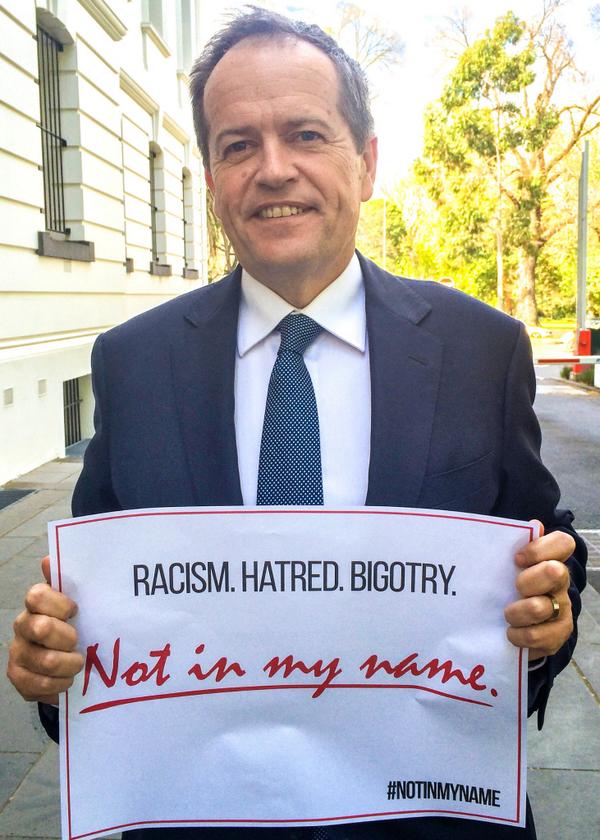
We can see this strategy more generally in the vacuous photos of
Labor leader Bill Shorten and other Party luminaries with signs
condemning racism and bigotry.


Embedded image permalink


Yet Labor, both left and right, supports the very policies stirring
up Islamophobia right now and when in government did nothing to fight
racism, hatred and bigotry. Its support for the Northern Territory
Intervention, its demonising of refugees and locking them up in offshore
and onshore concentration camps, its warmongering,  all add to racism,
hatred and bigotry.


The decision to cut a little bit of slack to the Left is another attempt to put lipstick on the Labor pig.


Yesterday it was the turn of former leadership contender, the man
with 60% membership support, Anthony Albanese. According to Katharine
Murphy in the Guardian Australia:


Anthony Albanese has signalled Labor has gone too far in
supporting the Abbott government’s national security agenda,
particularly the new “draconian” restrictions on press freedom which
would see journalists jailed for between five and 10 years.


But not to worry. Albanese makes clear in the same article he is a
true blue warmonger supporting the latest senseless western intervention
in Iraq, an intervention that will only in the long term increase the
power and appeal of fundamentalists like ISIS.


This comes on top of Melissa Parke voicing her opposition to the
national security laws in Parliament and abstaining (so I have been
told) on the vote.


A few weeks ago Parke and former speaker Anna Burke addressed a
Canberra Refugee Action Committee meeting to argue refugee policy must
change.


It is good to see this sudden bout of conscience from sections of
the group formerly known as the Left in the ALP. It reflects I think the
concern within the membership and that section of society horrified by
the bipartisan Labor and Liberal onshore and offshore concentration
camps and dismayed with yet another Labor supported war and the attacks
on our rapidly dwindling rights that entails.


However we need to be clear. Albanese, Parke and Burke not only
support the racist, misogynist, warmongering ALP; they are integral to
its racism, its sexism and its war mongering, not to mention its
‘caring’ neoliberalism.


Their opposition provides left cover for the dominant right wing. It
gives false hope to left wing Labor members. It might even win back a
few voters from the Greens.


Our task has to be to point out this reality and to talk to those
with illusions in Labor not to repeat the same errors of the past.


Let these champions of freedom and refugees actually join the
campaigns and mobilise ALP members and supporters. Why do you think they
don’t?


Senator John Faulkner

Senator John Faulkner


Public Pessimism, Political Complacency: Restoring Trust, Reforming Labor


The inaugural address of The Light on the Hill Society


   Senator John Faulkner


 Revesby Workers’ Club


7 October 2014


______________________________________________________________________________________________


I have always believed that politics is worthwhile.


This is not, nowadays, a popular view.


Important issues are, we are told, ‘above politics’— because politics,
by implication and expectation, are the province of the low road.


No more damaging charge can be made than to say someone is ‘playing
politics’ with an issue — because, by implication and expectation,
politics is a game played for personal gain and for entertainment.


But politics is one of the ways – the chief way – any democracy works
out solutions to its problems. Politics is a way to manage substantial
disagreements within a society or a community, and to bring about real
change for the better. Our politics is the expression of our values, our
beliefs, and our policy priorities. Politics is about the public good -
not private interest.


Widespread contempt for the practice of politics is not because
Australians have lost faith in what politics really is. It is because
too many Australians have come to see our parliaments, our governments,
our political parties, and our politicians, as practising not politics
but its opposite: a values-free competition for office and the spoils it
can deliver.


Individuals who transgress – recent examples being Peter Slipper and
Craig Thomson – are seen by many as representatives of the rest. There
is no doubt that the seemingly unending parade of current and former
politicians from both major parties through NSW’s ICAC has been the
icing on the cake as far as that view is concerned.


But these individual symptoms would not have as much impact if there
were not a deeper disease in our democracy – a deficit of that trust on
which democracies depend.


That trust is not – or is not necessarily – trust of any particular
individual involved in the political process, but trust in the political
process itself. Trust that elections are conducted fairly and that they
produce legitimate governments, even if they are not the government of
our preference; trust that in the balance between the executive
government, the parliament and the courts, each fulfils a specific and
necessary role; trust that even where we disagree with policy, it is
shaped and delivered by our representatives, and that those
representatives make informed judgments based on sound advice.


On that consensus of trust rests the operation of our government: the
ability to make decisions, even where they may not be popular; the
ability to pass laws, even where they constrain or disadvantage some
members of the community; the ability to assign what may be scarce
resources to priorities, and therefore not to other areas or interests.


On that consensus of trust has been built some of humanity's most courageous efforts to transform the world in which we live.


Without that trust politics is a contest of personalities, not ideas — a
contest with no more relevance than an episode of Masterchef, for
without trust in the political process how can any of us believe that
the votes we cast influence the future direction of our country?


Our trust in our democratic institutions – such as parliament and our
political parties—has been undermined by how they’re portrayed and
perceived, but also by the very real flaws in our democracy.


Spiralling costs of electioneering have created a campaigning ‘arms
race’ – heightening the danger that fundraising pressures on political
parties and candidates will open the door to donations that might
attempt to buy access and influence.


In Australia, as in other democracies around the world, the potential
for large and undisclosed sums of money in election and campaign
financing has become more and more a matter of concern to the public.
These perceptions of possible influence need not be only concerns about
potential undue influence in the narrow sense of how government
decisions are made, but in a broader sense: concerns that parties and
politicians dependent on large donors will be if not compliant, then at
least receptive, or that large donors and fundraisers may get access
that others do not.


The perception of undue influence can be as damaging to democracy as
undue influence itself. It undermines confidence in our processes of
government, making it difficult to untangle the motivation behind policy
decisions. Electors are left wondering if decisions have been made on
their merits.


I have argued long and hard about the need for reform of our electoral
funding laws at the federal level. Unfortunately, I was not persuasive
enough, particularly when I was the Special Minister of State, to
convince the Senate in 2008 and 2009 that reform was desperately needed.
My attempts to make our system more transparent and freer from
corruption and improper influence failed.


Political parties have a privileged position in our electoral system.
Any Australian can run for public office, but a registered political
party can be formally recognised on the ballot paper, nominate multiple
candidates, and receive public funding for its election costs if its
endorsed candidates receive at least 4 percent of the vote.


In the past four Federal elections, over $180m of public funding has
been dispersed, with over 80 percent of that funding going to the two
major parties.


Political parties also have privileged access to the Electoral Roll,
and are exempted from most of the provisions of the Privacy Act in their
use of the Roll, as long as that use is for ‘electoral purposes’.


I believe these privileges bestowed by legislation should entail strict
conditions and obligations for those political parties which qualify
for them. 


Party members and the public at large are entitled to know that
standards exist, that these standards are open to public discussion and
public assessment, and that they must be met.


Principles of integrity, transparency, and accountability are crucially
important to Labor’s reforming agenda, because they enable that faith
in the political process which is critically important to the consensus
building that makes reform possible. And those principles are equally
important to Labor’s historic values of fairness and equality, because
they safeguard our movement against vested interests, self-interest and
unfair advantage.


The stench of corruption which has come to characterise the NSW Labor
Party must be eliminated. Failing to act is not an option. The Party
which gave you Eddie Obeid, Ian Macdonald and Craig Thomson, and
promoted Michael Williamson as its National President must now be open
to scrutiny and its processes subject to the rule of law. In fact, I
believe that the rules and decisions of all political parties should be
justiciable, and that State and Federal Governments should consider
making a party’s eligibility for public funding contingent upon it.


All party tribunals must be impartial, independent and conducted
fairly. The party must insist on a binding code of conduct for its
candidates, parliamentarians and officials. The recent NSW Annual
Conference adopted my proposed rule change to include this in the NSW
Rules. All state and territory Conferences, and National Conference,
should do so as well.


The practice of factions, affiliates or interest groups binding
parliamentarians in Caucus votes or ballots must be banned. Factional
binding is inherently undemocratic. It allows a group with 51% of a
subfaction, which then makes up 51% of a faction, which in turn has 51%
of the Caucus numbers, to force the entire Caucus to their position.
This Russian doll of nested factions is profoundly undemocratic and, as
we have seen in NSW, wide open to manipulation.


The reforms I proposed as Special Minister of State included significant measures:


  • to reduce the donations disclosure threshold from its current level of $12,800 to $1,000 and remove indexation;


  • prohibit foreign and anonymous donations;


  • limit the potential for 'donation splitting' across branches, divisions or different units of parties;


  • require faster and more regular disclosure of donations; and


  • introduce new offences and significantly increase penalties for the breach of electoral law.


These reforms would have enhanced the transparency and accountability
of political donations, and I would like to think they would have had at
least some dampening effect on the behaviour that is being exposed at
ICAC. It is quite clear that much more needs to be done in this area.
The recent events in New South Wales should motivate all Australian
political parties to work together for far-reaching and long-overdue
reform of our electoral donations, funding and expenditure laws. This is
a real and urgent challenge for all political leaders.


Elections must be a contest of ideas, not a battle of bank-balances.


And in that contest of ideas, our political parties are paramount. In
our two-Party system the selection of candidates and the setting of
policies within the major political parties have perhaps as great an
influence on Australia’s governance as do general elections. It is
therefore essential that Australia’s political parties are open,
transparent and democratic – no code-words, no cabals, no secret
handshakes.


Labor at its best would take the lead in fixing this problem.


The best way for Labor to demonstrate that we are genuine in pursuing reform is to reform ourselves.


Labor is dedicated to the basic principle that any community or country
is stronger when all of us are involved in our democracy. That no
government can find the best solutions to the challenges facing us,
without drawing on the abilities of all of us – the experience, the
knowledge, the skills, the judgement of the whole community, and not
just a section of it.


Our Party was formed with the conviction that working men and women
could not get fair representation without participation: that no
government would consider the needs, or could reflect the priorities, of
those with no seat at the table. When we talk about Labor’s commitment
to democracy – our long history of broadening and defending the
franchise, of striving to safeguard the fairness of the electoral system
– we are talking about policies that reflect those central, original
understandings. No-one speaks for us who does not accept our right to
speak for ourselves; and no policy solution can be considered complete
if the list of those contributing to it is partial.


Labor’s original structures, although they varied from colony to
colony, all reflected that basic belief in democratic participation. As
the Party grew, the sheer practical difficulties of a mass party in a
nation the size of the continent were resolved with models based on
delegation.


Labor’s model of delegated democracy was cutting edge – in 1891.


A hundred years ago, the difficulty of travel and communication around
our huge continent made party members’ direct participation in the ALP’s
organisation impractical. The solution was for local members to
delegate their democratic rights. Today, the problem and the solution
are out-of-date. Today, the abuse of those structures too often smothers
Party democracy. Today, we can – and we must – do better.


We now have technologies that offer unprecedented opportunities for the
direct and secure communication of information. More importantly, they
provide us with unprecedented opportunities for interaction. And they
are woven into everyday life so inextricably that, to the younger
members of our community especially, they have become invisible.


They offer a huge potential to party organisation and for party
democracy, and at the same time fundamentally change expectations of
participation, engagement and responsiveness.


Labor’s structures and organisation must be based on the way people
today organise, communicate and participate – not, as our current
structures are, on the ways that their grandparents did.


Australian political parties have begun, perhaps more slowly than in
other countries, to engage with social media as a campaigning tool. Even
I am now on Facebook. But the internet – email, Facebook, Twitter,
blogs, YouTube, Google Plus – are not merely broadcast mediums with the
potential to reach many more people for much less effort and expense
than mail-outs or television advertisements. They are immediate,
interactive, tools for community activism. Their prevalence – and for
more and more Australians, their pervasiveness – has, I believe,
profoundly changed our ideas of community and our expectations of what
community – and political – involvement looks like.


Twenty-first century democracy is very different from even ten or
fifteen years ago: self-organising, intolerant of top-down management,
expecting interactivity and immediacy.


Geographically based organisation, face-to-face meetings, complex
procedures and delegated decision-making suited an Australia without
cars or telephones – even the Australia of my student days, before faxes
or answering machines, let alone mobiles and emails. But it does not
suit Australia today.


Structures which were once the cutting-of edge delegated democracy are
now used as a way to prevent democracy, to prevent open debate, and to
consolidate the power of the powerful in the Labor Party. As a Party, we
should be true to our heritage and embrace real reform and an
opening-up of the Party’s decision-making processes. We should to the
maximum extent possible adhere to the fundamental principle of one
person, one vote.


Labor’s recent leadership ballot was an important first step. But
promising first steps should not be confused with the journey’s end.


There are many more steps on the road to increased participation of voting members.


Our branch members have been the lifeblood of our Party, but branch
attendance is no longer the only way to measure activism and commitment,
and voting in our internal ballots ought not to be regarded as a reward
earned only by those able to negotiate arcane rules.


Preselections ought to be the opportunity to determine who is best
suited to campaign for Labor values in the community and legislate for
them in Parliament. They must have wide participation from Labor members
and supporters.


I support the community preselections trialled in NSW with weighted
votes from Party members equalling declared supporters, and I believe
they should become the rule, rather than the exception.


I continue to argue for a full, statewide ballot of all Party members
to preselect candidates for upper houses – again, to test their
abilities to persuade and represent their statewide constituency.


I proposed this rules change at the recent NSW Annual Conference and it
was defeated. I do not pretend to think that this reform or others, are
or will become more popular with factional managers and powerbrokers.


There are very few voices among those with formal or informal power
within our Party who are willing to contemplate, let alone advocate
change - despite the increasingly loud calls for reform from members and
branches.


I may be beating my head against a brick wall, and of course I will be
criticised for what I am saying tonight, but I cannot in good conscience
cease to argue for a cause I believe is both right, and necessary, and
in the Labor interest.


Labor’s State and National Conferences should also become more
representative and democratic. Conferences must begin to include a
component of directly elected delegates. Every eligible member of the
party should have the opportunity to vote for these Conference
delegates, through direct member ballots. Proportionate regional zones
could ensure broad geographical representation.


The existing and widening chasm between Labor’s commitment to democracy
and our internal practice of it, between our focus on the future and
our antiquated organisation, undermines our policy agenda and casts
doubt on its authenticity.


And I say to those who resist the opening up of our structures to more
participation and more democracy, because they see their control over
managed and pre-negotiated outcomes slipping away – stop clinging to the
wheel. You are steering us straight for the rocks.


Those anxious about reform should remember that Labor’s history has been, first and foremost, a story of reform.


Reform of the laws covering Australians in the workplace and the unions
that represent them, to ensure fair pay, bargaining power and decent
conditions. Reform of the economy – whether the creation of the
Commonwealth Bank at the beginning of the last century or the floating
of the dollar at its end. Reform in health care, from the PBS to
Medibank to Medicare. Reform in social policies, from the old age
pension to equal pay for women.  And let us not forget, Labor’s history
of reform is also the story of reforming ourselves.


These are all aspects of the same single story – a story that has
changed and evolved over twelve decades, but one where the hopes and
aspirations, as well as the flaws and struggles, echo and repeat.


Previous generations of Labor activists, parliamentarians, and Party
officials took on the, at times, difficult and thankless task of
reforming the Party and its policy. One lesson that Labor’s history has
for us is that we cannot expect to repeat past successes if we shirk
similar burdens.


The other lesson our history has is that the decisions of our
predecessors were shaped by circumstance, rather than being timeless and
immutable expressions of Labor’s spirit.


Our debates over the best path into the future have always involved
attempts to lay claim to our past. Each generation of Labor members and
activists chooses their own icons and their own history, to become their
guide and justification – a weapon of choice in battles against foes
within and without the party.


But mistaking history for immutable truth obscures not only the reality of the present but the opportunities of the future.


While Labor’s structures and rules have always been the expression of
the best efforts of the men, and later men and women, of the time, they
have also been the expression of their blind spots and assumptions, and –
like our policies –– require regular revision to meet the challenges of
a changing world.


We need a clear-eyed appreciation of our past to take a hard look at our future direction.


Although it was once accepted wisdom that Australia “rode on the
sheep’s back” and it is now often said that we ride the wave of demand
for our

mineral wealth, the truth is and always has been that Australia’s
prosperity has been carried on the backs and built from the labours of
the working men and women of our nation.


The labour of their hands has built our country’s wealth; the labour of
their hearts and minds have built our country’s strength, the great
social contract that underpins the fundamental egalitarianism which has
set Australia apart. 


Through collective action and mutual support, these men and women
strove in the 19th century to build better lives, better working
conditions, better opportunities, for each other and for those who came
after.


By the 1890s, their efforts were directed both through the union
movement and through the Australian Labor Party, and that commitment to a
better and a fairer future was directed not only to those who shared a
workplace or an industry. It had become a broader commitment to all: a
commitment that could only be realised through government action and
through legislation.  The Australian Labor Party was born from that
desire to ‘make and unmake social conditions’: one of only seven parties
with formal, organisational ties to the union movement, in the world.
These ties are the defining characteristic of a labour party.


For twelve decades those ties have strengthened us, and challenged us.
They have been a constant of our history and I believe will be a
constant of our future.


But the form and structure of those ties has changed many, many times.


Labor was founded 123 years ago and in the decades since, Australia,
Australia’s workplaces, and Australia’s union movement have changed, in
ways unimaginable to our founders.


And the Labor Party has changed with them. Indeed, the history of Labor
is the history of these changes – sometimes dramatic, sometimes subtle,
reforms to the relationship between the Party and the movement, to the
formal rules that govern our interaction.


It is only in recent generations that Labor has ceased to constantly re-evaluate and re-assess that relationship


It is only in recent years that the rules we have, which are a product
of the power struggles of the past and the accidents of history, have
come to be seen as the holy grail of Labor organisation by some members
of the Labor Party and the labour movement – who are, it must be said,
advantaged in internal party power distribution by the way things are
today.


But we do not become less a Labor Party because we scrutinise ourselves.


Any more than we are less a Labor Party because of the reforms instituted by McKell or Whitlam. 


The Party’s relationship with affiliated trade unions should no longer
be just about direct control through 50:50 rules and the like, but about
greater consultation and involvement. We have to make the relationship
more meaningful and mutually beneficial.


Trade unions are, and will remain, important for Labor. They are a
social force, albeit a declining social force, but in an age where
collective identity and endeavour is fracturing, union membership is a
connection to shared efforts and progressive ideas: to economic justice,
to solidarity, to co-operation.


We will not meet the urgent challenges of this new century without
those values, and unions, and union membership, build and strengthen
those values in our community.


But all too often unions are viewed – and behave – in the Labor Party
as just institutions: large, faceless institutions controlled by union
secretaries, who are in turn obedient to factional cartels. And right
now, that is how union engagement with the Labor Party works.


I would like to see our Party actually engaging union members: giving
them a voice, giving them a vote. They should have a direct say, just as
Party members should have a direct say, not have their opinions
filtered through layers of delegation.


Influence over ALP policy should depend on the strength of your case
and the quality of your argument, not on the number of members you claim
belong to your union – a claim which, as we have seen recently, does
not always accord with reality.


If union secretaries fear they will make no impact on Labor without the
bully pulpit of the 50:50 rule, they should ask themselves how they
expect the Labor Party to persuade the community to support policies and
candidates which union leaders cannot even persuade ALP members to
endorse.


To deepen and strengthen the relationship between the labour movement
and the Labor Party, rank and file unionists, working people, must
represent their unions in our Labor Party. If we are to be a Party
representing a movement, then we need to ensure that working people are
present and playing a role in key decision making forums.


Australia is changing, and the Party and unions have to change with it.
We need to rebuild Labor from the grassroots – not the top down. 


We have to democratise our Party and reach out to union members and
involve them directly in the Party’s decision making processes.


This should lead to a deeper relationship with organised labour as a fundamental part of our Labor community.


To achieve this, the Party should encourage members of affiliated
unions to join the Party and participate directly in Party decisions and
deliberations.


For the purpose of determining union affiliation numbers, unions should
only be able to count members who have agreed to their membership being
counted towards that affiliation in an opt-in system.


All union delegates to Party Conferences should be elected through a
ballot of union members, conducted under the principle of proportional
representation, and should not be appointed without election. Unions
should be required to amend their own rules, to fulfil this objective.


Our current State Conference structures provide 50% representation to
affiliated unions – which represent only a portion of the 17% of working
people who belong to a union at all. This must change. 


The component of conference delegates directly elected by party
members, which I spoke of earlier, should increase over time, while the
percentage of both the delegates elected by Electorate Councils, and
those elected by unions, should reduce in tandem. I would hope to see a
structure with 60% of Delegates elected by the membership, 20% by the
Affiliated Unions and 20% elected by Electorate Councils, reached in
stages over the next three National Conferences.


Even then, there would still be a positive disparity or “over
representation” of union proportionality to unionisation of the
workforce. There would also be an incentive for union members to have a
direct relationship with the Party as well as participating through
their union. Indeed, being active in both Party and union would provide
additional opportunities to participate – activism would be rewarded.


Democratic, representative, transparent systems ought to be the goal of
all political parties, but most especially the Australian Labor Party,
which was founded on the belief in the value of the participation and
representation of everyone in our democracy.


This belief, deep in the bedrock of our Party, gives us both an unique
advantage and an unique responsibility in facing the challenges that now
confront our Australian democracy, which remains, however flawed, not
only the best but the only way for our country to work together to face
the challenges of this new century.


Labor has at our core the values which can revitalise our political
system and restore faith and confidence in the power of democratic
government to resolve our differences and surmount our difficulties.


Having those values, we cannot turn our back on the problems our
democracy now faces. It is our challenge, and our duty, to take the lead
in restoring trust.


We must start by reforming ourselves.